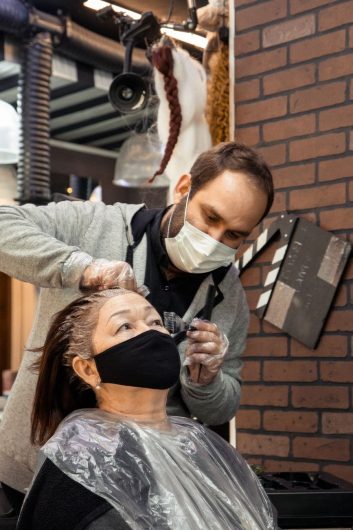
The first few gray hairs can bring up a surprisingly big question: Should you cover them, blend them, or simply let them become part of your look?
If you’re not ready for permanent gray coverage, semi-permanent color can offer a softer, lower-commitment option. Rather than completely masking every silver strand, it can subtly blend early gray, refresh your overall tone, and add shine.
At OP Hair Salon in Overland Park, our stylists can help you determine whether semi-permanent color is appropriate for your amount of gray, natural hair color, texture, and long-term goals.
What Is Semi-Permanent Hair Color?
Semi-permanent color primarily deposits pigment onto the hair rather than providing the same level of permanent color change associated with traditional permanent formulas.
Because of this, it can be useful for clients who want to experiment with color or soften the appearance of their first gray hairs without immediately committing to ongoing permanent root coverage.
Results vary depending on the formula, hair condition, porosity, and amount of gray.
Can Semi-Permanent Color Cover Gray Hair?
It may blend or soften the appearance of gray, but it shouldn’t automatically be expected to provide complete, opaque coverage.
This distinction is important.
If you have a few scattered silver strands, a semi-permanent service may make them less noticeable while preserving some natural variation.
If you have substantial or resistant gray and want every strand covered, your stylist may recommend a different color service.
Gray Blending vs. Gray Coverage
These approaches have different goals.
Gray blending reduces the contrast between gray and pigmented strands while allowing some silver to remain visible.
Gray coverage aims to make gray strands significantly less visible or completely covered.
Neither option is inherently better. The right choice depends on how much gray you have and how much maintenance you want.
Why Semi-Permanent Color Can Be Appealing for First Gray
Early gray is often scattered rather than concentrated.
You may not want to establish a permanent root-touch-up routine simply because you’ve noticed several silver strands.
A semi-permanent approach can allow you to:
- Experiment with color
- Soften gray contrast
- Enhance shine
- Maintain a natural-looking appearance
- Avoid an immediate commitment to permanent coverage
What Will the Finished Color Look Like?
The result depends heavily on your starting point.
Gray strands may reflect or accept color differently from surrounding pigmented hair. Instead of producing identical strands, a customized service may create subtle tonal variation.
This can make the finished color look more dimensional and natural.
Gray Hair Can Behave Differently
New gray strands may sometimes feel:
- Coarser
- Drier
- More wiry
- Less predictable
Some gray hair can also be resistant to color.
Your stylist will consider these characteristics when deciding whether semi-permanent color is likely to provide the result you want.
Porosity Affects Color Results
Porosity can influence how quickly hair accepts and releases artificial pigment.
Previously highlighted, chemically processed, or naturally porous areas may absorb color differently from healthier sections.
This can affect how evenly a semi-permanent shade fades.
A professional assessment can help identify these differences before selecting a formula.
How Long Does Semi-Permanent Color Last?
Semi-permanent color gradually fades, and longevity varies from person to person.
Factors include:
- Washing frequency
- Hair porosity
- Shampoo formulation
- Heat styling
- Sun exposure
- Starting color
- Color depth
- Hair condition
Rather than assuming a fixed lifespan, your stylist can recommend a realistic refresh schedule based on your hair.
Washing Habits Matter
Frequent washing can cause color to fade more quickly.
To help extend the appearance of your color:
- Use products recommended for color-treated hair.
- Avoid unnecessarily hot water.
- Condition regularly.
- Follow your stylist’s maintenance recommendations.
Your cleansing routine should still meet your scalp and hair needs.
Heat Styling Can Affect Color Longevity
Repeated high heat can contribute to dryness and may affect how your color looks over time.
Use a heat protectant before:
- Blow-drying
- Curling
- Flat-ironing
- Hot-brush styling
Keeping the hair conditioned can also help preserve its shine.
Does Semi-Permanent Color Make Growing Out Gray Easier?
It can provide a softer transition than permanent color because it gradually fades rather than creating the same strong line between newly grown gray and colored roots.
For someone considering eventually embracing natural silver, a lower-commitment color strategy may therefore be worth discussing.
Your stylist can help create a gradual plan as your amount of gray changes.
Semi-Permanent Color Isn’t the Only Gray-Blending Option
Depending on your goals, your stylist may recommend:
- Semi-permanent color
- Demi-permanent color
- Highlights
- Lowlights
- Glossing
- Strategic gray blending
- Permanent coverage
Sometimes a combination of techniques creates the most natural result.
Semi-Permanent vs. Demi-Permanent Color
These terms are sometimes used interchangeably in casual conversation, but they can describe different types of professional color services.
Their performance, longevity, and ability to affect gray can vary.
If gray blending is your goal, ask your stylist which type of formula they recommend and why it is appropriate for your hair.
What If Your Gray Is Resistant?
If your gray strands are particularly resistant, semi-permanent color may not deliver the amount of coverage you expect.
Your stylist may instead suggest a demi-permanent or permanent formula, depending on your desired result.
The goal is to select the least intensive service that can realistically achieve your expectations.
Highlights Can Blend Early Gray
For some clients, strategically placed highlights can reduce the contrast between silver and darker hair.
This can be especially useful when gray is concentrated around the temples, hairline, or part.
Highlights can also create dimension without covering every strand with artificial color.
Lowlights Can Add Depth
If your hair has become visually lighter or lacks contrast as gray increases, lowlights can add depth around silver strands.
A customized combination of highlights, lowlights, and tonal refinement may produce a more dimensional result than all-over color.
Don’t Automatically Reach for Permanent Box Dye
Seeing your first gray can make a permanent box dye seem like the easiest answer.
However, committing to a dark permanent color can create future maintenance and color-correction challenges.
Potential issues include:
- Noticeable root lines
- Color buildup
- Uneven fading
- Difficulty changing your shade later
- A more complicated transition to natural gray
If you’re unsure what direction you want to take, a consultation can help you understand your options before making a permanent change.
What About Color-Depositing Products?
Color-depositing shampoos and conditioners can sometimes help maintain a chosen shade between salon visits.
However, repeated pigment deposition can accumulate unevenly, particularly on porous sections.
If your goal is subtle gray blending, use pigment strategically rather than continuously adding color without assessing the result.
A Professional Consultation Comes First
Before choosing a gray-blending service, your stylist can evaluate:
- Amount of gray
- Gray distribution
- Natural hair color
- Hair texture
- Porosity
- Previous color
- Desired level of coverage
- Desired maintenance schedule
- Long-term plans for your gray
Your future goals can influence the best choice today.
What Happens During a Semi-Permanent Gray-Blending Appointment?
1. Gray Assessment
Your stylist examines where your gray is appearing and how noticeable the contrast is.
2. Goal Discussion
You decide whether you want blending, tonal enhancement, or stronger coverage.
3. Formula Selection
A shade is selected to complement your natural color and desired result.
4. Application
The color is applied according to the chosen service.
5. Processing
The formula processes according to professional and manufacturer guidelines.
6. Rinse and Condition
Your hair is cleansed and conditioned.
7. Final Evaluation
Your stylist checks the balance between the gray and pigmented hair and discusses maintenance.
How Often Will You Need Salon Visits?
There isn’t one schedule that works for everyone.
You may choose to refresh your color when:
- Gray becomes more noticeable
- Your tone begins fading
- Shine diminishes
- You want to adjust the shade
Because semi-permanent color is lower commitment, your maintenance routine can often be more flexible than permanent gray coverage.
When Semi-Permanent Color May Not Be Enough
A different service may be more appropriate if you:
- Want complete gray coverage
- Have extensive resistant gray
- Want a significant color change
- Need consistent root coverage
- Have substantial existing color that requires correction
A professional consultation can help establish realistic expectations.
Consider Your Long-Term Gray Goals
Your first gray appointment doesn’t have to lock you into one path.
You can choose to:
Blend → reassess → increase coverage → maintain gray → or gradually embrace natural silver.
As your gray pattern develops, your color strategy can change with it.
Questions to Ask Your Stylist
Before your appointment, ask:
- Can semi-permanent color blend my gray?
- Will my silver strands remain visible?
- How much coverage should I expect?
- How long is the color likely to last?
- Would highlights provide better blending?
- Would demi-permanent color be more appropriate?
- Can this approach support my goal of eventually embracing gray?
- How often should I schedule a refresh?
Embracing Gray Is Always an Option
Some people want their first gray hairs gone immediately.
Others discover that they like the added dimension.
You can choose full coverage, subtle blending, or no color at all.
The best gray strategy is the one that fits your appearance, lifestyle, and desired maintenance level.
Why Choose OP Hair Salon?
At OP Hair Salon in Overland Park, we help clients navigate changing hair color with personalized strategies rather than one-size-fits-all formulas.
Whether you’re noticing your first silver strands, interested in softer gray blending, or considering a long-term transition toward natural gray, our stylists can evaluate your hair and recommend an approach that fits your goals.
Not sure whether to cover or blend your first gray hairs? Schedule a consultation at OP Hair Salon in Overland Park to explore your options before committing to a higher-maintenance color routine.
Leave a Reply